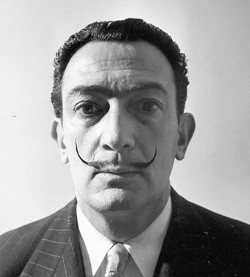
Andre Breton
Breton's Gallery
Breton's Facts
Andre Breton Book Results
Andre Breton Book Results
As an Amazon Associate, I earn from qualifying purchases.
Breton's Facts
Andre Breton Book Results
Birth
Andre Breton was born in 1896 as the son of a shopkeeper in Tinchebray (Orne). His childhood was spent in the coasts of Brittany.Psychiatry
Breton studied medicine and later psychiatry. His early interest was in being a psychoanalyst and met Freud in Vienna in 1921. During the first world war Breton served in the neurological ward in Nantes, but never qualified as a psychoanalyst.Andre Breton Book Results
As an Amazon Associate, I earn from qualifying purchases.
The birth of surrealism

In the Second Manifesto Breton stated that the surrealists strive to attain a"mental vantage-point ( point de l'esprit ) from which life and death, the reral and the imaginary, past and future, communicable and incommunicable, high and low, will no longer be perceived as contradictions."After writing the Surrealist manifestos Breton continued to publish his poems and , during the 1930s published several. These included Mad Love - which used the Cinderella myth. Breron is also famous for his prose and one of his acclaimed pieces is called Nadja (1928), which is a portrait of Breton and a mad woman, a patient of Pierre Janet. The title refers to the name of a woman and the beginning of the Russian word for hope
Communism
From 1927 to 1935 Breton was a member of the French Communist Party . Although he broke with the party in disgust with Stalinism and Moscow show trials, he remained committed to Marxism. In June and July 1938 Leon Trotsky, exiled Russian revolutionary, and Breton, collaborated in Mexico on the writing of an extraordinary "Manifesto for an Independent Revolutionary Art." This declaration remains the most eloquent expression yet produced of the commonality of interests of the artist and the revolutionary Marxist. The statement began: "Without any exaggeration one can say that human civilization has never before been exposed to so many dangers."The authors took note of the "ever more widespread transgression of those laws" that govern intellectual creation, particularly in Nazi Germany and Stalinist Russia. "If ... we reject all solidarity with the caste that is currently ruling the USSR, it is precisely because, in our eyes, it represents not communism but its most treacherous and dangerous enemy," the manifesto explained. "The communist revolution," it continued, "is not afraid of art. It has learned from the study of the development of the artistic calling in the collapsing capitalist society that this calling can only be the result of a clash between the individual and various social forms that are inimical to him." The declaration concluded: "Our goals: the independence of art-for the revolution; the revolution-for the liberation of art once and for all ."When the Nazis occupied France, Breton fled to the United States with Marcel Duchamp and Max Ernst. He held there a broadcasting job and arranged a surrealist exposition at Yale in 1942.Death
Andre Breton died in Paris on September 28, 1966.Andre Breton Book Results